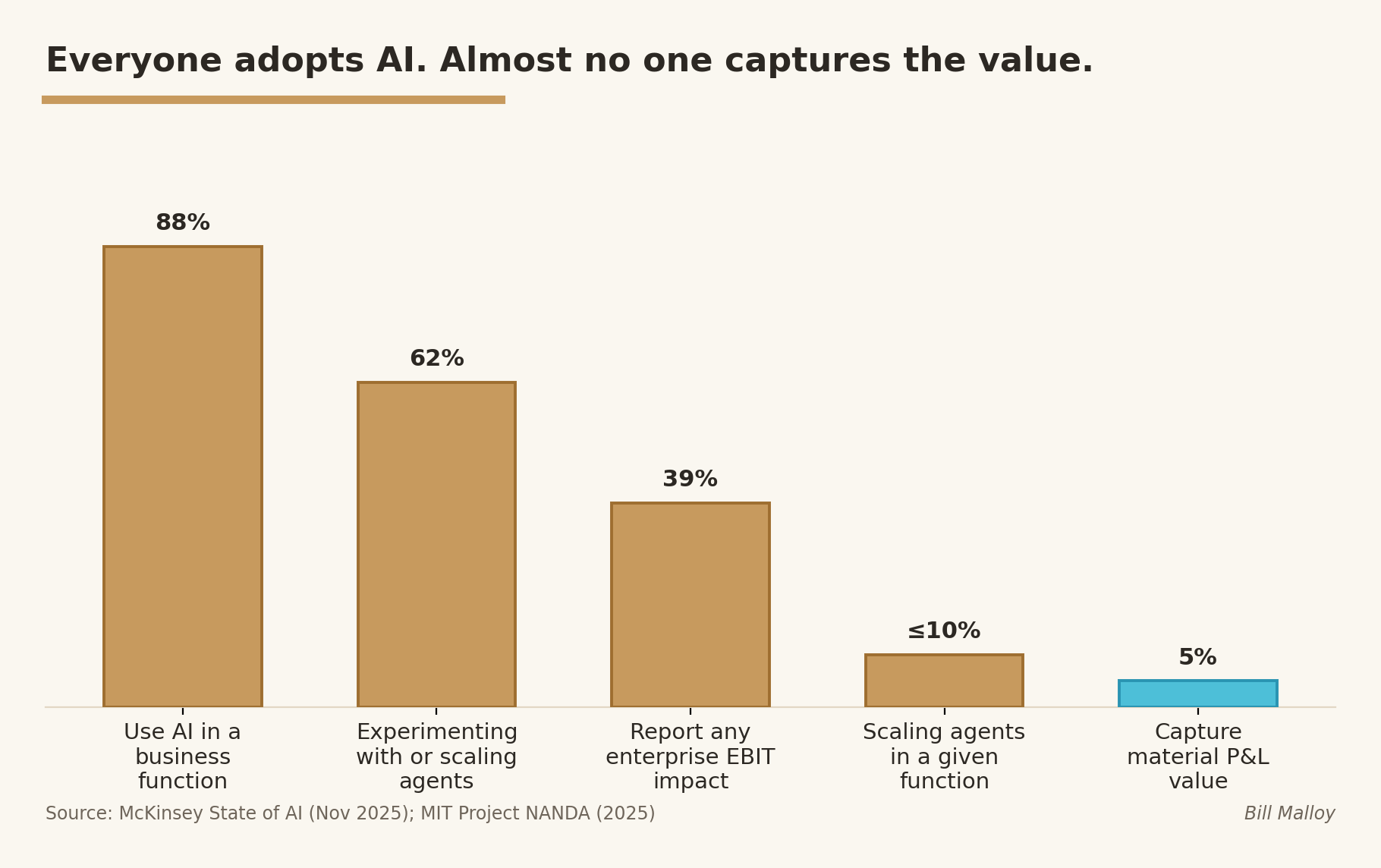
MIT’s Project NANDA studied real deployments and found that 95% of enterprise generative-AI pilots have produced no measurable return, despite $30–40 billion invested. McKinsey’s November 2025 survey says the same thing from the other side: 88% of organizations use AI in at least one function, but only 39% can tie any EBIT impact to it.
That gap is not a model-quality problem. Generation is already excellent. What’s expensive is everything downstream of generation: deciding whether the output is right, framing the problem well enough that the output is worth having, and owning the consequence when it’s wrong. Call it the verification tax — and it’s why cheap generation raises, not lowers, the price of human judgment.
Bill Malloy is an innovative investor and technologist with a track record of successfully investing and building companies. He is currently focused on building and investing in engineering driven software companies as well as helping philanthropies that address the full life cycle of cancer diagnosis and treatment.
Bill balances a number of philanthropic positions, currently serving the Malloy Foundation as well as co-founder of the PEERS Network. He previously served as a board member and treasurer for the Equinox Center. He holds a MBA from the University of Southern California and an undergraduate degree in Engineering from Clemson University.
View all posts by Bill Malloy