The constant
I have made the same bet three times in thirteen years, and this week the third one is doing something the first two never could: giving itself away to every seller who wants it.
The bet is simple to state. Enterprise deals are not won in pipelines. They are won inside organizations — in the shifting map of champions, blockers, budget owners, and quiet influencers that no CRM field has ever captured. Every generation of technology makes that hidden relationship layer a little more visible. Back the company that makes it most visible for its era, and you tend to do well.
The data on why this matters has only gotten louder. Gartner’s research on the B2B buying journey puts the typical buying group for a complex enterprise solution at six to ten decision makers. Meanwhile, Salesforce’s State of Sales research (7,775 sales professionals surveyed) found reps spend just 28% of their time actually selling — the rest disappears into deal management, data entry, and tool-juggling across an average of ten tools. So the modern seller faces a committee that keeps growing, with less time than ever to understand it. That gap — between the complexity of the buying organization and the seller’s capacity to map it — is where all three of my bets live.
Generation one: record the relationship
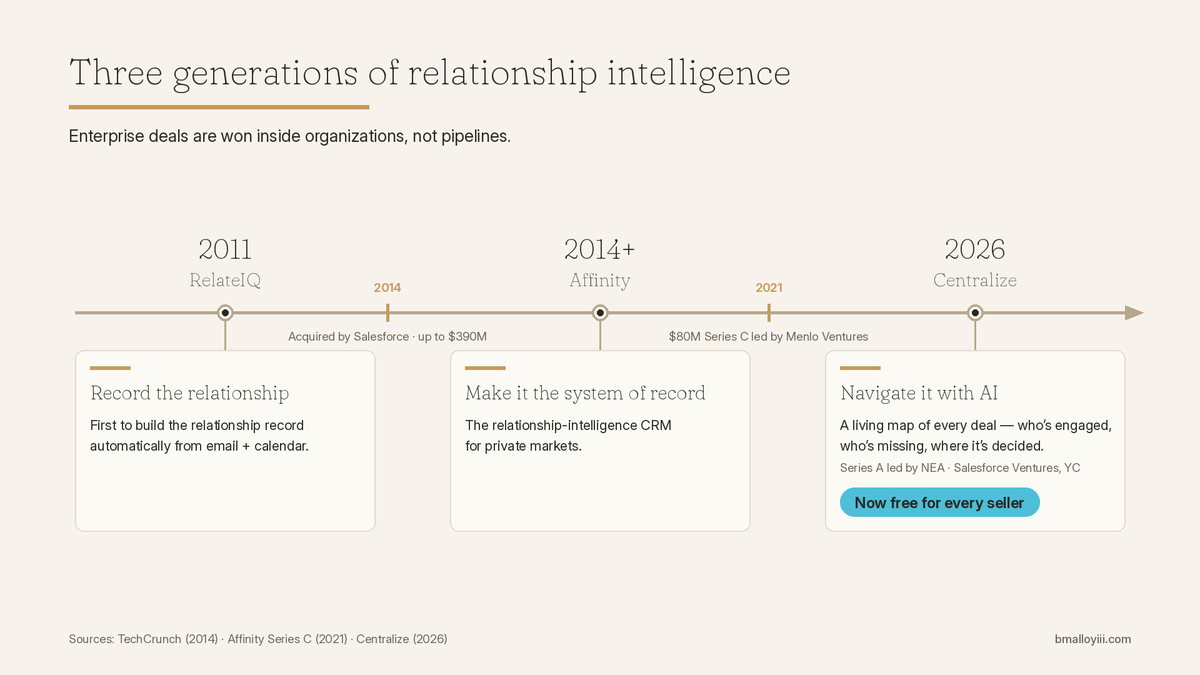
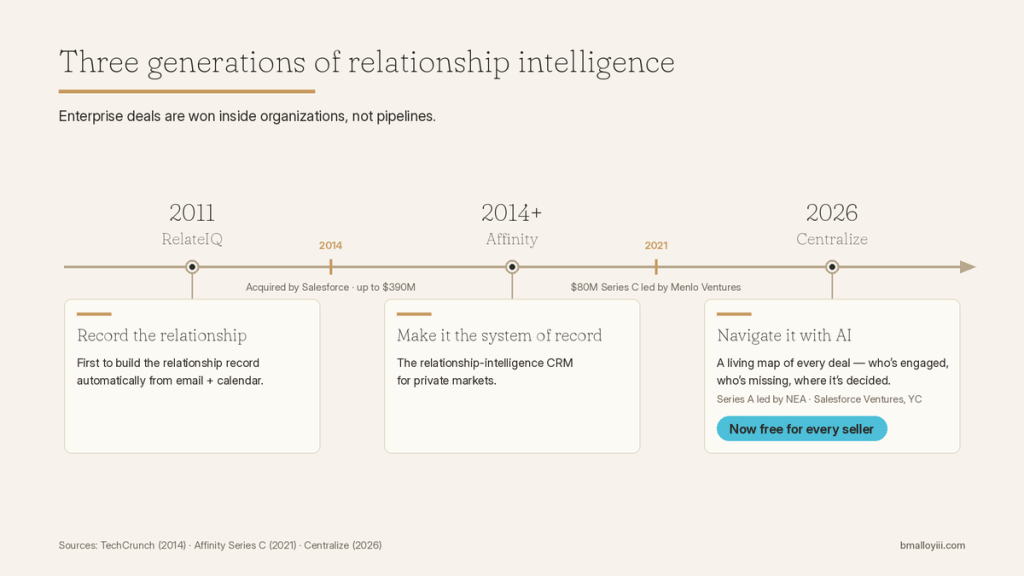
In the early 2010s I led our firm’s investment in RelateIQ, founded in 2011 by Steve Loughlin and Adam Evans. The idea was radical for its time: instead of asking salespeople to type their relationships into a database, mine the data exhaust — email, calendar, communications — and build the record automatically. TechCrunch called it “big data meets CRM.” Salesforce called it something more emphatic: in July 2014 they acquired the company for up to $390 million, one of the larger CRM acquisitions of that era, and later rebranded it SalesforceIQ.
Here’s the honest part, because a thesis you can’t stress-test isn’t a thesis. Salesforce retired SalesforceIQ as a standalone product in 2020. The acquisition validated the idea and Salesforce built on the technology as intelligence moved into its core platform — but the first generation could capture relationship data far better than it could reason about it. It could tell you who emailed whom. It couldn’t tell you who actually mattered in the deal. The idea was right; the technology of the moment could only take it so far.
Generation two: make it the system of record
Affinity, where I led our investment and still sit on the board, took the same insight to the people whose entire business is relationships: venture capital, private equity, investment banking. If generation one recorded relationships, generation two made the relationship graph itself the system of record. By its 2021 Series C, Affinity was serving 1,700+ customers across 70 countries and powering more than 500,000 new introductions a month — the plumbing beneath a meaningful share of private-market dealmaking. In private capital, “relationship intelligence” stopped being a feature and became the category.
But Affinity proved something narrower than the full thesis. Dealmakers paid for relationship intelligence because their deal is the relationship. The much larger population — the millions of enterprise sellers navigating buying committees — still ran on gut feel and whatever the CRM happened to contain.
Generation three: navigate it with AI
Which brings me to Centralize, the third bet — and the reason for the timing of this piece. Centralize calls itself “the GPS for enterprise deals”: a living map of the relationships behind every deal, built automatically from CRM, email, calendar, and call data, that shows who’s engaged, who’s missing from the buying committee, and where the deal will actually get decided. Founders Rachit Kataria and Will Wang built revenue tooling from inside the machine — Wang prototyped and launched Huddles at Slack; Kataria was a tech lead at AtoB and a founding engineer on Facebook Shops — and started the company in late 2023 through Y Combinator.
The progression matters: generation one recorded the relationship. Generation two made it the system of record. Generation three navigates it — the map answers questions (“who owns budget?”, “who haven’t we met?”) before the meeting, not after the quarter. Early customers like LangChain report cutting sales ramp time by over three weeks, and Brex reps report reaching senior decision-makers in days instead of weeks, per the company’s Series A announcement. That round was led by NEA, with Salesforce Ventures and Y Combinator participating — and I’d note the quiet poetry of Salesforce funding generation three, twelve years after acquiring generation one. (Disclosure: I’m an investor in Centralize, as I was in the two before it.)
The AI piece is where I’ll plant a flag, because most of the “AI for sales” market has it backwards. The dominant pitch is automation after the interaction: auto-drafted follow-ups, auto-logged calls, auto-generated summaries. Useful, but marginal. The real value is context and judgment before the meeting — knowing which of the eight stakeholders is drifting, which champion changed roles, which thread went cold. Salesforce’s own 2024 research found 81% of sales teams now experimenting with or deploying AI, and teams using it saw revenue growth at 83% versus 66% for those without. My read: that gap comes mostly from better-informed selling, not faster paperwork.
Where the data pushes back
Now the strongest case against my thesis, in its best form. Gartner reports that 75% of B2B buyers prefer a rep-free sales experience. If buyers increasingly want no seller in the room, does mapping seller relationships matter — or am I three bets deep into a layer that’s evaporating?
It’s a real tension, and I’d be lying if I said it never gave me pause. But Gartner’s own follow-on finding is the answer: buyers who engage a rep alongside digital tools are 1.8x more likely to complete a high-quality deal than those who buy alone. Buyers don’t want fewer relationships; they want fewer low-value interactions. That raises the bar for every remaining human touch — which is precisely an argument for showing up with the map already drawn.
Now: every seller
Today, Centralize becomes available free for every seller. Not a trial. The core product is free for the individual rep, with no credit card required. The U.S. Bureau of Labor Statistics counts nearly 13.4 million Americans in sales occupations. RelateIQ’s insight reached them only through an acquirer. Affinity’s reached the dealmaking elite. This generation reaches anyone with a quota and an inbox — and that democratization, not the financing, is the story.
A falsifiable prediction, so you can hold me to it: within 18 months, live relationship maps will be table stakes in enterprise selling the way call recording became after 2020. What would change my mind: if individual sellers adopt the free product but their teams don’t follow, that says relationship intelligence is a personal edge, not an organizational layer — and generation four will look different.
Three bets, one idea: deals are won inside organizations. The technology finally caught up. If you carry a quota, the map is now free — I’d draw yours before your competitor draws theirs.
Sources
- Centralize Series A announcement — Yahoo Finance, July 29, 2026
- Centralize — usecentralize.com
- Y Combinator launch: Centralize
- TechCrunch: Salesforce buys RelateIQ for up to $390M — July 11, 2014
- Affinity $80M Series C press release — September 2021
- Gartner: The B2B buying journey
- Salesforce State of Sales, 5th edition (Dec 2022) — 28% selling time
- Salesforce: Sales teams using AI 1.3x more likely to see revenue increase (2024)
- U.S. Bureau of Labor Statistics: sales employment, May 2024


